Individuation and the 'caress' of learning experience

Posted by dasfseegdse Rabu, 12 Januari 2011 0 komentar
I was struck by Coleridge's idea of 'individuation' as a life force which he articulates in his "Hints towards the formation of a more comprehensive theory of life". Coleridge equates individuation and life:

"I define life as 'the principle of individuation', or the power which unites a given 'all' into a 'whole' that is presupposed by all its parts. The link that combines the two, and acts throughout both, will, of course, be defined by the 'tendency to individuation'"

This is not dissimilar from Jung's view:
"I use the term 'individuation' to denote the process by which a person becomes a psychological 'in-dividual,' that is, a separate, indivisible unity or 'whole.'"

The emphasis on 'wholeness' suggests to me something about realising a symmetry: the symmetry of time (diachronic) and the symmetry of structure (synchronic). The symmetry of time relates to the patterns of agency in the world. The symmetry of structure relates to the topological patterns in the world. At some point, diachronic symmetry and synchronic symmetry come together. It is these processes which I am pursuing with
a. game theory for diachronic symmetry
b. topology for synchronic symmetry.
There are particular moments of experience where this interplay between diachronic symmetry and synchronic symmetry are revealed to us. I think music can do this particularly well (I've been very struck by all the Mozart that radio 3 have been playing in the last two weeks. I've never been a great Mozart fan - I've always found it a bit too 'smooth', but there is something exquisite in the perfection of his lines). But then there are very sensual things: the symmetry of a caress, for example.

Caresses (in my experience, at least!) always seem to have an 'envelope': effectively attack, sustain, release.  A musical phrase has the same. Essentially,  a beginning, middle and end. Our knowing of an envelope may be our recognising it's symmetry. Our diachronic experience of it is shaped by our synchronic awareness of its form. And particularly in the case of caresses, the tiny envelopes make up bigger ones, and so on. That we might lose ourselves and revel in the sensation of it all is simply to say that the tuning between our own symmetry and what is done to us is so perfect that conscious control is suspended; time can stand still. 

Music is possibly the only thing we have as a 'respectable' form of it. Maybe most other things in life, including learning, aspire to this condition. But so much learning can seem disproportionate; the symmetry is out-of-kilter, corrupted by asymmetrical structures within institutions. Occasionally, it isn't. I think Salman Khan's videos are very delicate and subtle.. it can be done.

This raises the question about how we might go about thinking about envelopes in teaching and learning. Those subtle gestures, jokes, tone of voice, expression of vulnerability, openness, all can contribute to something which people can tune into. But the envelope exists between individuals and 'performers'... To really understand it, you have to model both.

Which brings me back to game theory and topology. Each communicative act between two modelled participants in a game is performed in some context. It may be that each act has it's own envelope, its own symmetry. If we take one of Salmon Khan's videos, model his performance, and play the model in the context of a modelled learner... that might be do-able. What would it tell us? 

A lot about deciding what to do in institutions is about understanding their nature, and the nature of the people within them. Understanding individuation and the symmetries that surround people is part of this. Everything in institutions is political. Most important strategic decisions depend on guesswork, if not (at worst) on the whims of whoever is in charge. How do we judge the impact of a redundancy programme, for example? We guess. We hope the 'good ones' don't leave, and the 'bad ones' do. But we don't do this any more with the weather, for example; we have better forecasting. Forecasting is about knowing the nature of something to the extent that your judgements and decisions are more informed. Modelling the subtleties of individuation and interaction between learners and teachers, learners and resources, etc might mean that our strategic decisions might become a bit more informed and efficacious.


Baca Selengkapnya ....

Notes on an 'Impossible Degree'

Posted by dasfseegdse Selasa, 11 Januari 2011 0 komentar
Coming to a University near you soon! Sign-up for "Degree Impossible!" - the degree you will never pass! With us, you will learn how to fail better...

We're doing this because we are experts in failure. Unlike other Universities, we're not going to pretend life is a success. Because ultimately, you and we cannot escape defeat. Degree Impossible! sounds miserable, but that is not our intention. We are here to help you cope. But we can't help you succeed. Because success is impossible.

Each year of Degree Imposssible! comprises 6 modules (six impossible things!) in which you have to do something impossible. In the final year there is an 'alchemical project' which is a double module. But you will not get that far. You can only fail. And then you have resits to worry about. You will never progress from year 1, and you will never be awarded a certificate. You can resit indefinitely - if you pay your fees. At some point you will decide you have had enough, and you will leave.

We are here to help you cope. Degree Impossible! will leave you feeling despondent and exploited. You will have failed at everything you have turned your hand to. But you will see it will have been worth it. The more you fail, the more it will have been worth it. You will curse your failure of judgement in signing up for the course in the first place. When you finally leave, you will curse your inability to have acted more decisively sooner. This is not to say that non-graduates of the "Degree Impossible" do not go onto careers which (to others) might appear 'successful'. They often do, after a period of recuperation and adjustment to the financial burden they have brought upon themselves (*more debt*). But they always know their success is short-lived.

What do you get for your money? You will be affiliated to our institution. This you might find useful as you try to cope with failure. We do. You will be surrounded by experts in their own failure to support you through your failure. We will help you cope with the impossibility of your dreams. We will chase rainbows with you, but we will know what lies at the other end, and be ready to pick you up from your disappointment. We know that what you want to achieve is impossible. We ourselves found it to be impossible. But we have learnt how to deal with failure. We have grown - as you will. You may learn our coping strategies. Some people call these 'skills'. We have also found that failing does not mean you have to be miserable. Some people call this 'knowledge'. With this knowledge, you will fear less. And fearing less will equip you to fail better.


Baca Selengkapnya ....

Nature, supernature and a game of communication

Posted by dasfseegdse Senin, 10 Januari 2011 0 komentar
Any religious conviction is an assertion of reality that exists outside subjective experience. But the assertion that there is only subjective experience and nothing beyond it is itself metaphysical conjecture. I suspect that this is why debate about reality can quickly turn ill-tempered. The heat in the debate rests at the interface between personal identity and its association with metaphysical and existential propositions.

A lot depends on what we mean by subjectivity. I think subjectivity is the name we give to a process of regulation between individual minds and bodies, and a real (i.e. Objective) world of matter, society and agency. Many would disagree: those, for example, who postulate 'mental causes' for experience (but who can never say 'what caused the cause..?'); those who postulate behavioural causes for experience (but who ascribe the cause of behaviour to behaviour, and discount any 'inner life'). My underatanding of subjectivity starts with thinking through how subjectivity may be infused with a reality about which some degree of naturalistic objectivity is possible. There may be other aspects of that reality about which naturalistic objectivity is not possible, but those aspects are nevertheless also causally efficacious on subjective experience. This is, of course, a supernatural conjecture - but one which I am not uncomfortable with - maybe only because my own personal identity, intellectual endeavour and belief has developed along these particular lines.


To begin with, we can characterise a 'game' being played between homeostatic systems, whereby the communications of those systems, and the consequent responses from neighbouring systems are constitutive of their homeeostasis. This is the analogue of subjective experience, where individuals maintain homeostasis through making communications, which are themselves constituted by the state of those individuals and constitutive of the the environment which in turn is causal on the future states of agents. A simple NetLogo program can represent this sort of game, and the agents and their different types of communications (which are constitutive of the different regulating mechanisms of the agents) are shown in different colours. Some agents are not connected. These are red, which means their unmanaged variety is at a critical level: they are in oscillation. Regulation only comes through communication.

I've been thinking about this aspect of it. When we talk about 'learning' in an abstract sense, we reflect on our own experience, and mistakenly abstract a learning individual in isolation from anyone else. It's a similar sort of category error to that of a private language. We cannot conceive of an individual in absolute isolation from any social context. (I remember Margaret Archer arguing with Roy Bhaskar about whether there was always a social element in being. She didn't think so, he did. I think he was right.) In essence, this means that sentient existence and an environment of communication are co-determining in the same way as Lovelock's Gaia theory presents 'life' and 'atmostphere' (again using cybernetic models).

I want to go further and express the 'game' that is played between environment and agency. In my model, each agent has three regulating levels (based on the Viable System Model). Each of these is essentially a number which determines the probability of handling communications appropriate to that level of regulation. With each communication, there is a calculated pay-off. The objective of the game is to maintain homestasis through continuing to make successful communications. What might this look like mathematically? With fairly random numbers, it would take this sort of form where A might have a start state which would determine three possible game states from where B might then move.

However, this is a repeated game, so there are emergent strategies. I have a bit more work to do on this model! If I start to play with deltas for the emergent strategy, is there a way in which I can identify the 'double binds' which emerge from particular communications?

The key thing, it seems to me, is to find a way of characterising the agency of someone who might manipulate this model. In my NetLogo model, agents are dragged around the screen (hopefully to places where they are more likely to have successful communications). Agents might learn of these dragging events. They might detect difference in the agency of dragging for beneficial communicative effect, and the agency of dragging for detrimental communicative effect. This might create the grounds for identifying some sort of contradiction, upon which the beginnings of a topology might emerge.

Baca Selengkapnya ....

Expectation Horizons and Double Binds

Posted by dasfseegdse Jumat, 07 Januari 2011 0 komentar
Mezirow makes much of Popper's idea about the Horizon of Expectations. I'm wondering how a horizon of expectations maps onto a 'topology on being'. Here I am now, with all my dreams, all the things which are immediately responding to things happening around me, my sense of self... and the things I have to do. How do I decide what I have to do? How do I set about doing the things I have to do? Why don't I do some of the things which I (deep down) know I've got to do? But I can only see as far as my horizon... My horizon changes with each move I make. And my vantage point doesn't always allow me to see dangers in time to avoid them.

Where I can see my landscape stretched ahead of me after having done these things, I will summon up the will to do them. But there are areas of my landscape which become very dark, upon which I can't situate my 'doing' of certain things.. it seems to lead me into a dark tunnel, and I don't know where it will go: I fear it. I also fear not doing these things.

If I ask myself: what do I fear in doing it? I would say 'getting lost/trapped/sucked-in/enslaved or simply failing'. If I ask myself what do I fear in not doing it? I would say "being attacked, loss of reputation, loss of job/income, etc". Losing is on both sides. When I realise that losing is on both sides, I can then ask "How do I win at losing?", and then I can find a way of doing the things I don't want to do. It's to step outside the contradiction. It is to see the 'black hole' for what it is, and to reconceive my topology around it.
Can I plot this...?
"What do you fear in using learning technology?"
"What do you fear in not using learning technology?"
And say the contradiction is there and it can be programatically identified...
We could also ask "What other areas of your life do you fear doing and fear not doing?"
Each of these might be labelled as 'black holes' of understanding. Can the topology whereby we can move above the black holes can also be articulated?

Maybe I'm looking for powerful metaphors which can be created and articulated online. Perhaps like a 'game creator': you get to create your obstacles and then have to work out how to negotiate them in play.


Baca Selengkapnya ....

Time and the symmetries of Universe and Mind

Posted by dasfseegdse Kamis, 06 Januari 2011 0 komentar
I've been reading John Duffield's Relativity+ over the last few days. It's got me thinking (which I think is Duffield's intention, rather than providing a perfectly worked-out theory, which it clearly isn't). I notice how horrible the physics community have been to him, which is a bit sad. Not dissimilar to the treatment that Elinor Ostrom got from the economics community when she won the Nobel prize last year. Duffield's probably no Nobel prize winner, but he's a very enthusiastic communicator who is asking the sort of fundamental questions that professional scientists are taught not to ask.

Duffield's thesis is basically that mass/particles are basically knots in space, which is stressed and tensed in different places. Light, distance and time therefore present problems. Our concept of time depends on our concept of distance, and that depends on light. A photon as a particle can also be seen as a patch of tensed space, and the metaphor of the elasticity of space also helps us appreciate how light can be seen to have particle-like and wave-like characteristics. As a particle, light is subject to gravity, but Duffield argues that gravitational effects work a bit like electrical resistance, and that the more stressed a patch of space is, the more slowly light moves around it. Time is an emergent effect of this. It's what we construct from the motion of light.

It strikes me that Duffield is mapping out is a different sort of symmetry for the universe than the one we are used to. He does it by analogy: by alluding to symmetries within ourselves. Would it be at all surprising if the symmetry we detect in the Universe has some correlation with the symmetries of our understanding? "As above, so below" says the Emerald Tablet. What does 'being in tune with the Universe' mean? To what extent is it political?


Baca Selengkapnya ....

Analysing the knowledge performances in OER

Posted by dasfseegdse Selasa, 04 Januari 2011 0 komentar
I've been exploring the remarkable one-man OER show of Salman Khan recently: http://www.khanacademy.org. I stumbled upon it because my Christmas project was to get to grips with topology, and the maths resources are fantastic (although he hasn't done anything on topology). But the experience has also set me thinking about why this is fantastic. After all, most of the resources out there are not that great: a lot of very dull lectures from Harvard and MIT. But Khan has charm, and he's very comfortable with the technology he's using.

I think it's to do with his knowledge performance. Looking at the four forms of knowledge I've been thinking about recently, I think we can analyse his performance.
1. person form
2. content form
3. tool form
4. purpose form

I think the person form is very strong. Khan's enthusiasm both for his subject and for his teaching is conveyed very strongly. The content form is also very good - the use of the computer blackboard and his narration all work extremely well (even his slightly annoying tendency to 'spell things out' on the board adds to the charm of what he does). Most of the topics he teaches have a strong tool-form - maths particularly. What is being conveyed is the use of mental technology (equations, etc), and Khan is good at explaining what it might be used for. Finally, the purpose form of the knowledge performance (or perhaps the ethos) is increased by the endorsement of Bill Gates, but also by Khan's own belief in what he's doing.

I've also been looking at resources on economics and game theory (more maths). I was quite struck by some resources from Yale, which was a simple video of a lecture. I think there are differences in degree as to the knowledge performances here and it might be possible to be explicit about it. The person form of knowledge I initially thought was quite good, but the content (for the viewer) is not so great.. how different it would be to have Khan's computer blackboard.. Again the tool form of the knowledge is there (because it's mathematical) but the examples are a bit abstract and not particularly exciting, and there's the fact that it's from Yale, so a strong 'purpose' or 'ethos' form. But then I changed my mind slightly, because this teacher is not talking to me, he's talking to the students in the room. And in fact he's just talking, and I began to think "they must be getting a bit bored": there was something slightly inauthentic about this performance which Khan's performances do not show.

I may be being unfair, but the distinctions do seem to help... OER may only take a few really gifted people like Khan who are outside academia to go off and just cover a whole range of knowledge because they love it. How many proper academics are really going to do that? What have we been paying for??

Baca Selengkapnya ....

Bunuel's 'That obscure object of desire'

Posted by dasfseegdse Minggu, 02 Januari 2011 0 komentar
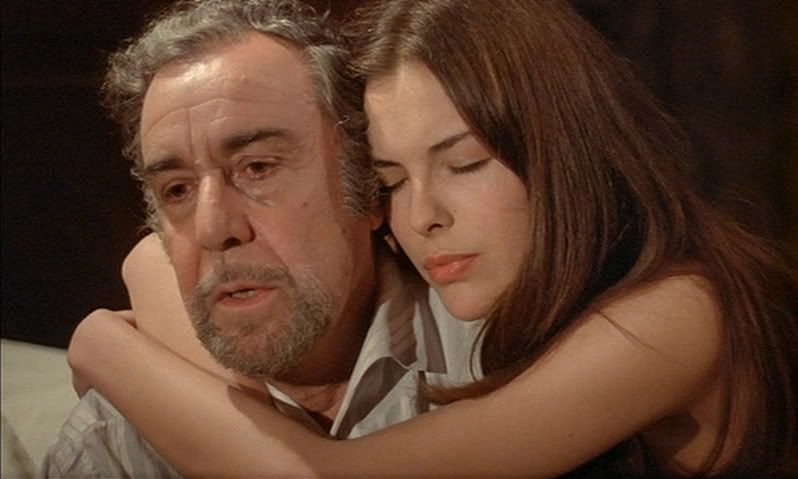
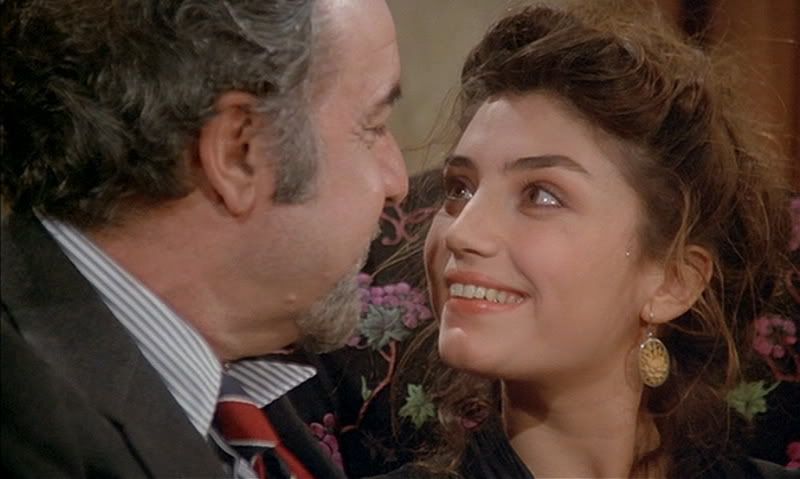
In Bunuel's last film, the lead female character is played by two actresses, with both the audience and the hapless hero (Fernando Rey) being none the wiser as to which is which. One teases and encourages him, the other pushes him away. The comedy revolves around the fact that he is the victim both of his passions, and of the unpredictability of his situation - an unpredictability underlined by the frequent violent terrorist attacks by the "Revolutionary army of the baby Jesus".

It is a superb example of 'double description' (although the choice of two actresses was an afterthought!), and particularly how contradictory descriptions describe a complex topology of understanding which can have the vertiginous effect of a 'black hole'. I think the theme of the film is 'wanting', and this is making me think about broader themes relating to education, servitisation and marketing. The confusion that Fernando Rey displays is also making me think about the 'topology' of his experiences: his is a tortured rationality which always sees clearly to a horizon, only to be frustrated as the horizon is illusory as he treads the rim of some crazy topological knot-like form or a black hole...(which?)

We might be tempted to think of him as a victim, but I don't think this is the case. What he learns he discovers in himself: he can only ever be mad with himself. With each manic act he understands the hopelessness of his condition. But I think this is the condition of all wanting - Bunuel has been able to establish the conditions for revealing it most starkly. What Fernando Rey never does is to look at the patterns of his experience from a distance. That is left to the audience, who at a distance can map out more clearly what they are seeing.

I think the topology of wanting tends to be like a 'black hole'. With ever-increasing urgency it sucks us in, disorientates us, leaves us gasping for something to save us. (this reminds me of Bateson's 'complementary schizmogenesis'). The scramble to escape its clutches leads us to act: shopping, art, sex, religion and education are what we reach for. The art of the marketeer is to lead us to the 'black hole' in the first place; to position us in that pathology of wanting that we reach for the services and products they want us to consume. This is not to say that consumption is of itself pathological - it may be good - but the mechanism by which we come to want things is similar whether those things are good or bad.

I think that mechanism is a function of our personal topology, and that this is a topology of paradoxical surfaces punctuated (like the universe) with 'black holes'. Getting to know one's topology is at the heart of the human goods of education. But wanting to get to know one's topology is to walk on the rim of another black hole. Society and Universities both want to lead people into education. The coalesce in positioning learners on the edge of a black hole with all the questions about their futures and human life in general being thrown in the air. This could be (and I think often is) done cynically. Might it be better (and more honest) to sign-post the black holes that we know about, always carrying the caveat that "this sign also leads to a black hole"!

Baca Selengkapnya ....
Trik SEO Terbaru support Online Shop Baju Wanita - Original design by Bamz | Copyright of wallpaper dinding.