Salman Khan

Posted by dasfseegdse Minggu, 11 Desember 2011 0 komentar
Salman Khan (born Abdul Rashid Salim Salman Khan on 27 December 1965) is an Indian film actor. He has starred in more than 100 Hindi films. Salman Khan, who made his acting debut with a minor role in the drama Biwi Ho To Aisi (1988), had his first commercial success with the blockbuster Maine Pyar Kiya (1989).

Salman Khan is the eldest son of screenwriter Salim Khan and his first wife Salma, his paternal grandfather came to India from Afghanistan and settled in Madhya Pradesh whereas his mother is a Marathi Hindu. His stepmother is Helen, a former actress, who has co-starred with him in a few films. Salman Khan has two brothers, Arbaaz Khan and Sohail Khan, and two sisters, Alvira and Arpita.

Below you can find Salman Khan Wallpapers 2010 to decorate your desktop, hope you like them. I'll be updating the blog with latest Salman Khan Wallpapers 2010 as often as possible.


Salman Khan Wallpapers 2010

Salman Khan Wallpapers 2010

Salman Khan Wallpapers 2010

Salman Khan Wallpapers 2010

Salman Khan Wallpapers 2010

Baca Selengkapnya ....

Salman Khan

Posted by dasfseegdse 0 komentar
Salman Khan (born Abdul Rashid Salim Salman Khan on 27 December 1965) is an Indian film actor. He has starred in more than 100 Hindi films. Salman Khan, who made his acting debut with a minor role in the drama Biwi Ho To Aisi (1988), had his first commercial success with the blockbuster Maine Pyar Kiya (1989).

Salman Khan is the eldest son of screenwriter Salim Khan and his first wife Salma, his paternal grandfather came to India from Afghanistan and settled in Madhya Pradesh whereas his mother is a Marathi Hindu. His stepmother is Helen, a former actress, who has co-starred with him in a few films. Salman Khan has two brothers, Arbaaz Khan and Sohail Khan, and two sisters, Alvira and Arpita.

Below you can find Salman Khan Hot Wallpapers to decorate your desktop, hope you like them. I'll be updating the blog with latest Salman Khan Hot Wallpapers as often as possible.


Salman Khan Hot Wallpapers

Salman Khan Hot Wallpapers

Salman Khan Hot Wallpapers

Salman Khan Hot Wallpapers

Salman Khan Hot Wallpaperssa

Baca Selengkapnya ....

Salman Khan

Posted by dasfseegdse 0 komentar
Salman Khan (born Abdul Rashid Salim Salman Khan on 27 December 1965) is an Indian film actor. He has starred in more than 100 Hindi films. Salman Khan, who made his acting debut with a minor role in the drama Biwi Ho To Aisi (1988), had his first commercial success with the blockbuster Maine Pyar Kiya (1989).

Salman Khan is the eldest son of screenwriter Salim Khan and his first wife Salma, his paternal grandfather came to India from Afghanistan and settled in Madhya Pradesh whereas his mother is a Marathi Hindu. His stepmother is Helen, a former actress, who has co-starred with him in a few films. Salman Khan has two brothers, Arbaaz Khan and Sohail Khan, and two sisters, Alvira and Arpita.

Below you can find Salman Khan Wallpapers Latest to decorate your desktop, hope you like them. I'll be updating the blog with latest Salman Khan Wallpapers as often as possible.


Salman Khan Wallpapers Latest

Salman Khan Wallpapers Latest

Salman Khan Wallpapers Latest

Salman Khan Wallpapers Latest

Salman Khan Wallpapers Latest

Baca Selengkapnya ....

Salman Khan

Posted by dasfseegdse 0 komentar
Salman Khan (born Abdul Rashid Salim Salman Khan on 27 December 1965) is an Indian film actor. He has starred in more than 100 Hindi films. Salman Khan, who made his acting debut with a minor role in the drama Biwi Ho To Aisi (1988), had his first commercial success with the blockbuster Maine Pyar Kiya (1989).

Salman Khan is the eldest son of screenwriter Salim Khan and his first wife Salma, his paternal grandfather came to India from Afghanistan and settled in Madhya Pradesh whereas his mother is a Marathi Hindu. His stepmother is Helen, a former actress, who has co-starred with him in a few films. Salman Khan has two brothers, Arbaaz Khan and Sohail Khan, and two sisters, Alvira and Arpita.

Below you can find Salman Khan Wallpapers 2011 to decorate your desktop, hope you like them. I'll be updating the blog with latest Salman Khan Wallpapers 2011 as often as possible.


Salman Khan Wallpapers 2011

Salman Khan Wallpapers 2011

Salman Khan Wallpapers 2011

Salman Khan Wallpapers 2011

Salman Khan Wallpapers 2011

Baca Selengkapnya ....

Uninstalling EU...? (or why I am an Educational Cybernetician)

Posted by dasfseegdse Sabtu, 10 Desember 2011 0 komentar
The best tweet I saw today was "Uninstalling EU... 1% complete". There's some 'big stuff' happening at the moment.

The problem seems to be to get any clarity on the situation. The first step is identifying where the crisis is. I'm tempted to say it's not the Euro which is in crisis, or the EU... the economic crisis is a "crisis of economics". The uncertainty over causal connections stems from the collapse of the available models we have for making sense of the world. Interestingly (but predictably), the reaction to this collapse is one of denial: economics can't be wrong; we have to fix our institutions to make them fit the available models - and 'fixing our institutions' means different things depending on whether you are France, Germany, Greece or the UK.

But really, we should be concentrating on fixing our models! There is a theory-practice gap, and I don't think the practice can develop without some serious attention being paid to the theory.

This is familiar territory for learning technologists. There's long been a theory-practice gap in educational technology (and education in general). It's telling that there has been very little coherent theoretical development in 50 years, whilst there has been an inordinate amount of shifting of practice - usually to advance towards pre-existing theoretical positions (whether constructivist, instructivist or whatever). But it's rare to find work which looks at practice as it is and seeks to remodel the theory.

We urgently need to look at the world as it is. We need to look at the lived experience of people in the globalised, technological bubble that we have created for ourselves; not from the perspective of wanting to oppose it (although we might), but simply from the perspective of acknowledging that it has happened, and at some level we (collectively) wanted it to happen. But most importantly of all, we need to recognise that living in the bubble produces the conditions under which it gets harder to stand back from it and ask "what's going on?". We need to see the danger in that, and find ways of doing something about it.

I was struck in a recent meeting in my University that staff are increasingly being asked to study for PhDs, whilst at the same time are so busy that they have no space to think. That's the situation that technology is producing for us (and particularly the species of 'techno-education' which has taken over the University sector). We have to understand it to learn how to live with it and manage it. And we have to make space for ourselves (whether we are in a University or not) to think.

This depends on having tools to think with. As I see it, the study and theorising of 'organisation' is the only disciplinary area which can feasibly and defensibly examine the mechanisms behind everything from the atoms of matter, to the biology of the cells from which we are composed, to the psychologies that yield us consciousness and action, to the communications that we make, and the institutions and nations we build. This is why I'm a cybernetician. More importantly, though, because I see that the only hope for us is to teach each other our understanding of these mechanisms, I would say cybernetics on its own isn't enough. It must be an 'Educational Cybernetics' which recognises that however good its models might be, those models must be taught and learnt before any change is possible.


Baca Selengkapnya ....

Time, Ritual and Attachment

Posted by dasfseegdse Kamis, 08 Desember 2011 0 komentar
Susan Hiller has commented that the distinction between an object and an event is not a distinction about materiality, but about time: objects are events extended over time, she says. And so begins a conceptual mapping between  art objects, installations, happenings, etc.

My thinking about attachment to objects (for which I've just completed a paper for Cybernetics and Human Knowing which focuses largely on economics), is now extending to thinking about the biological mechanisms of attachments to events, rituals, seasons.... particularly acute at Christmas time.

In Louis Kauffman's work, the distinction between observer and object is tied up in Von Foerster's idea of Eigenform, and Kauffman has recently put time in there (at least this is my understanding) as a kind of operator. I think this conceptual formulation may be consistent with Hiller's thinking... but I don't necessarily find that it solves the attachment situation.

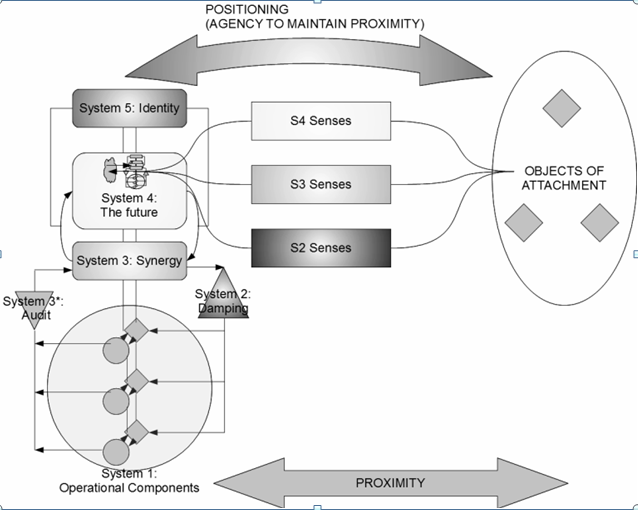
My rationale for attachment to objects is that proximity to the sensual perturbations of objects are maintained by the mechanisms of maintaining viability of the organism. This is shown in the diagram below:
Here the viability of the individual is dependent on the sensual perturbations of objects, and that in order to maintain viability the system has to take action to maintain proximity. In this way, I think that the model can explain Lorenz's baby geese. 

But what about time and events?

The key to understanding how that might work is to think of the role that anticipation might play in this process. I've been thinking that Kauffman and Von Foerster's work on Eigenform is not quite right (see http://dailyimprovisation.blogspot.com/2011/11/creativity-and-eigen-forms-of-life.html). Importantly, I wonder if the Eigenform is really an anticipatory system. As such, it belongs in System 4 of Beer's VSM (which is the part of the viable system which is looking towards the future). I have been trying to articulate (in a video for Kauffman) how an external reality might interfere with this idealised Eigenform, and in so doing 'create time'. Using musical experience as a metaphor (where time seems to move at different speeds at different moments) I've tried to express this as a continually shifting Eigenform
What's interesting here, with regard to attachment, is the extent to which the Eigenform/time relationship might be characterised as a 'form of life'. This in a sense is a higher-level eigenform, which encompasses (generates) the process of emergence of lower-level eigenforms. That means that the question of attachment to seasons, rituals and events may be a question of attachment to 'forms of life', or rather the question of attachment to the higher-level eigenform.

This may sound a bit half-baked. But I believe it has implications for the economic argument in my paper for Cybernetics and Human Knowing. Because in that paper, I make an argument for the compensation of one attachment for another (because we need this to be able to explain the exchange of goods). Now the idea of compensatory attachments might be extended to compensating goods for ritual and forms of life. With regard to education and religion, that is interesting, because it allows us to think what might be going on with St Francis of Assisi (and, incidentally, Stafford Beer!) and others who gave up possessions for spiritual enlightenment. 

There's much more to say on this, but a solid model for thinking is a useful start...


Baca Selengkapnya ....

Body and Screen

Posted by dasfseegdse Senin, 05 Desember 2011 0 komentar
In the Graham Greene short story "The end of the party", Greene describes how the two twin brothers, Francis and Peter, are playing hide and seek in the dark. Francis did not want to play, and had had a sense of foreboding about going to the party in the first place. Greene describes the intimacy of the relationship between the two brothers as they seek each other in the hide and seek game:
"for between Francis and himself, touch was the most intimate communication. By way of joined hands thought could flow more swiftly than lips could shape themselves round words. He could experience the whole progress of his brother's emotion, from the leap of panic at the unexpected contact to the steady pulse of fear, which now went on and on with the regularity of a heart-beat." 
This is, to me, what attachment is. It is fundamentally a sensual communication: the mothers voice, smell, touch with the baby - just as the touch between twin brothers similarly communicates "more swiftly than lips could shape themselves round words."

I'm thinking about this as I read Sherry Turkle's new book "Alone together".

Turkle is worried about our lives on screen. She sees physical togetherness separated by screens - peculiar techno-etiquettes which seem to run against common-sense behaviour (like the nanny who would only text her housemate because it "was intrusive to knock on her door"). I share many of these concerns, but I'm anxious to address them in a way which doesn't say "technology bad!".

The problem is attachment, and the fact that attachment may well be fundamentally physical. I'd wondered about an online space where attachments could form; but a friend pointed out that that is no more likely to be meaningful than virtual sex. But if it is about people being physically together, then we have a problem because somehow we have to stop the screen becoming a barrier and turn it into something convivial. The question is "how can technology help us to use the screen to face each other?".

I often sit on the sofa with my daughter and a laptop looking at her and my favourite youtube videos (lots of comedy). These are special moments for both of us, and something which we could not have done without Youtube and laptops. Both Youtube and the laptop enhances the moment of togetherness in an immediately to-hand way. But the attachment is with each other: we both recognise it as a special moment: we dwell in the moment.

Most of the time when I'm on the computer, this togetherness is not my experience. My thoughts are active, strategic and somewhat selfish: "how should I phrase this message to so-and-so?"; "I see so-and-so online.. should I skype them?"; "how many people have viewed my latest blog post?"; "what should my next blog post be?" (that one preceded me writing this!). I wonder if I'm not always seeking personal advantage or ego-boosting...

There may not be anything wrong with that, but it is important to recognise what it is not. Personally, I've found myself to be a happier person since I started blogging and tweeting, but my blog started out as a kind of therapy: I've learnt to blog as I've learnt not to be afraid. (Which makes me think that Luhmann is right about communication!) But on the other hand, I know so many people who live on Facebook in such an ever-active frame of mind that I'm left wondering about their deeper lives, their sense of self and ultimately their capacity to act sensibly. There is an aspect of 'life online' which is riddled with a deeper existential fear: do I blog and Facebook as a way of drawing attention away from my mortality?

It may be that only with catastophic loss does the power of attachment really hit home. At such moments, Facebook is not the place to be - it is not the moment when strategic communications are made. The place to be is directly dealing with those affected.

Greene's story ends in death, with such a loss. His Catholic doubt beautifully expressed:
"'Where's Francis?' but they were silenced by Mrs Henne-Falcon's scream. But she was not the first to notice Francis Morton's stillness, where he had collapsed against the wall at the touch of his brother's hand. Peter continued to hold the clenched fingers in an arid and puzzled grief. It was not merely that his brother was dead. His brain, too young to realize the full paradox, yet wondered with an obscure self-pity why it was that the pulse of his brother's fear went on and on, when Francis was now where he had been always told there was no more terror and no more darkness"


Baca Selengkapnya ....
Trik SEO Terbaru support Online Shop Baju Wanita - Original design by Bamz | Copyright of wallpaper dinding.